
Why Trying to Fix Your Partner's Problems Can Leave Them Feeling Alone
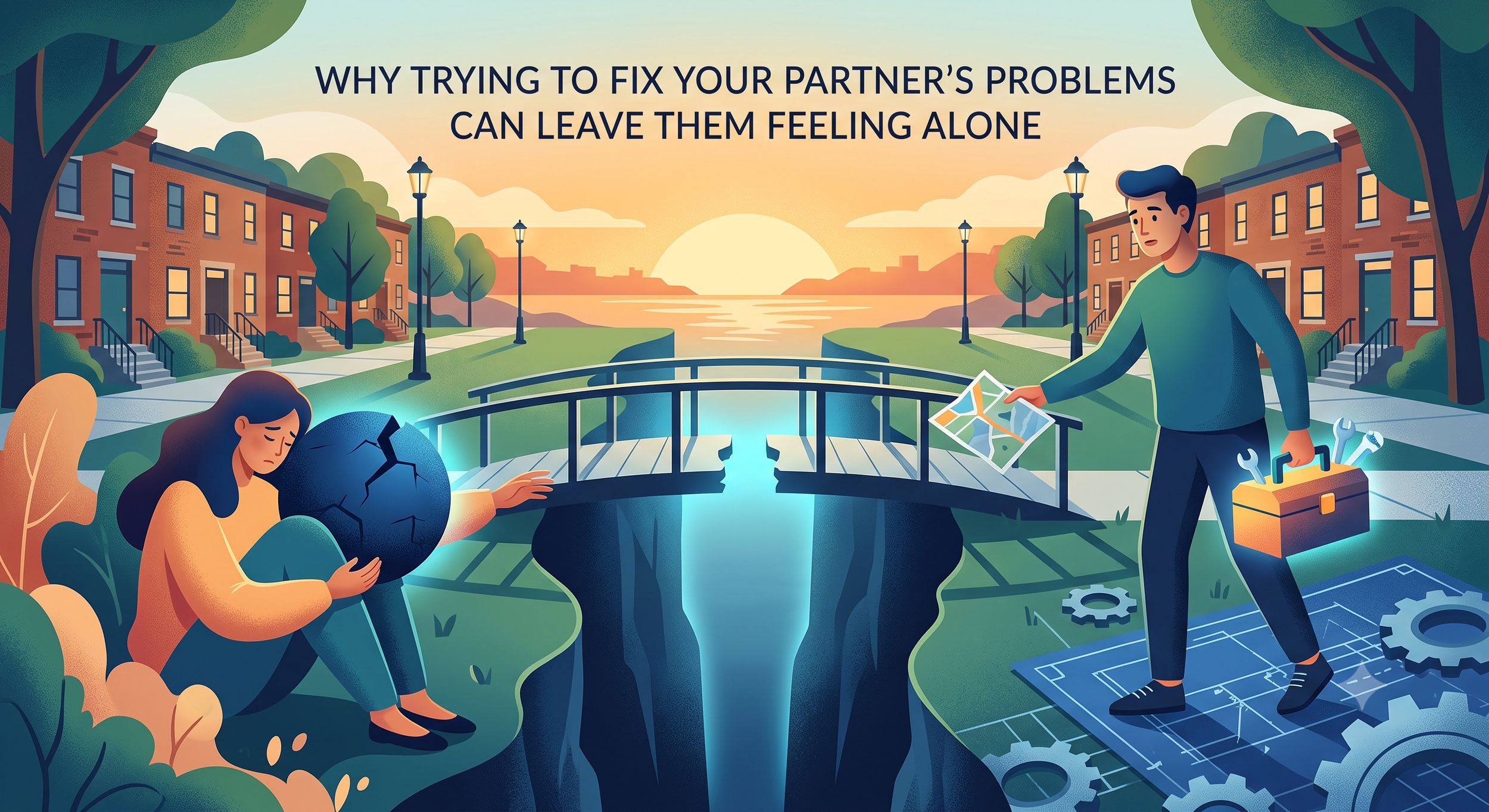
When people imagine relationship conflict, they often picture arguments, criticism, or raised voices. But some of the most painful moments between partners happen during conversations where both people are genuinely trying to care for one another.
Let’s take a fictional example of a couple to better illustrate this topic.
One evening, Maya came home exhausted after what had been an emotionally draining day. She dropped her keys on the counter, kicked off her shoes, and let out a long sigh.
Her partner, Daniel, looked up from the couch. "Everything okay?"
Maya hesitated before answering. "Not really. I had to present a project today, and halfway through, one of my coworkers interrupted me and completely dismissed my idea. I kept replaying it in my head all afternoon."
Daniel barely paused before responding.
"You should talk to your manager. Or maybe send an email explaining your perspective. If people don't know how you feel, nothing is going to change."
Maya nodded politely, but something inside her seemed to shut down.
After a few quiet moments she said, "I know there are things I could do. I wasn't really looking for advice. I just wanted someone to understand why today felt so awful."
Daniel was caught off guard. He hadn't been criticizing her. In his mind, he had been helping. If someone he loved was hurting, finding a solution felt like the most caring thing he could do.
Yet somehow, despite his good intentions, they both ended the conversation feeling disconnected.
If you've ever found yourself in either person's shoes, you're far from alone. This dynamic is one of the most common communication patterns I see in marriage counseling in Queens. One partner reaches for emotional connection, while the other instinctively reaches for problem-solving. Neither person is wrong—but because they're trying to meet different needs, they often leave the conversation feeling misunderstood.
For many people, offering advice is almost automatic. Maybe you've always been the dependable one in your family. Maybe your career revolves around solving problems. Maybe helping is how you've learned to express love. In those moments, listening without jumping in can actually feel uncomfortable, even irresponsible.
The challenge is that emotional conversations usually aren't asking for immediate solutions. More often than not, they're asking for something much simpler: "Can you be with me in this for a minute?"
That doesn't mean advice is never helpful. It simply means that timing matters. Before people are ready to solve a problem, they often need to feel that someone understands what they're experiencing.
This is one of the core ideas we work on in couples therapy in Queens. Partners are often surprised to discover that strengthening communication doesn't require changing their personality. Instead, it involves learning new relationship skills that help both people feel seen, heard, and emotionally safe.
Many of the couples I work with initially tell me, "I'm just not naturally empathetic," or "I'm a fixer—that's just who I am."
I don't usually see it that way.
While some people naturally gravitate toward emotional conversations, empathy is also a skill that can be practiced. Like any skill, it becomes easier when it's broken into small, manageable steps. Instead of trying to become the perfect listener overnight, you might simply pause before giving advice and reflect back what you heard.
Imagine Daniel responding differently.
Instead of immediately brainstorming solutions, he says, "That sounds incredibly frustrating. I can see why you've been thinking about it all day."
Nothing about Maya's work situation has changed. The coworker is still difficult. The presentation still happened.
But something else has changed.
She no longer feels alone in it.
Ironically, once people feel understood, they're often much more open to talking through possible solutions together. Emotional connection doesn't replace problem-solving—it makes problem-solving more effective.
That's why, in therapy, we often focus less on finding the perfect words and more on helping partners slow down long enough to understand each other's emotional experience. Those small moments of connection often have a much bigger impact than any piece of advice ever could.
Frequently Asked Questions
Is giving advice always a bad thing?
Not at all. Advice can be incredibly valuable when someone is looking for it. The key is making sure your partner feels emotionally understood before shifting into problem-solving. Sometimes asking, "Would you like me to just listen, or would it help to brainstorm together?" can make all the difference.
What if listening doesn't come naturally to me?
That's completely normal. Many people are naturally wired to solve problems rather than process emotions. Fortunately, empathy isn't simply a personality trait—it's a relationship skill that can be learned and strengthened with practice.
How do I know whether my partner wants empathy or advice?
If you're unsure, ask. A simple question like, "What would feel most helpful right now?" gives your partner the opportunity to tell you what they need instead of leaving you to guess.
Can couples therapy really improve communication?
Yes. One of the primary goals of couples therapy in Queens is helping partners recognize the communication patterns that leave them feeling disconnected. Once those patterns become visible, couples can begin replacing them with new ways of responding that foster trust, emotional safety, and closeness.
When should we consider marriage counseling?
If you and your partner find yourselves having the same arguments over and over, feeling unheard, or struggling to reconnect after conflict, it may be time to seek support. Working with a therapist doesn't mean your relationship is failing. Often, it means you're investing in learning the skills needed to strengthen it before resentment has a chance to build.
Looking for Marriage Counseling in Queens?
Healthy relationships aren't built by having the perfect advice or never making mistakes. They're built through moments of emotional connection—moments where each partner feels understood, valued, and supported.
If you're looking for marriage counseling in Queens, I help couples improve communication, break unhelpful patterns, and strengthen the emotional bond that brought them together in the first place. Whether you're facing recurring conflict, feeling disconnected, or simply want to build a stronger relationship, therapy can provide the tools and guidance to help you move forward together.
Learn more about my approach to marriage counseling on my website.
About the Author:

Michal Goldman, LCSW, is a couples therapist in Queens specializing in Emotionally Focused Therapy (EFT) for couples, premarital counseling in NY, and discernment counseling. She helps couples move from disconnection to understanding and connection— whether they’re rebuilding trust, navigating ambivalence, or learning to communicate more effectively.
Learn more about her work or schedule a consultation at michalgoldmanlcsw.org/about.
